
Look at the map and notice the world
How Google Maps led me to the best slice of pumpkin pie of my life

A long series of coincidences
and word-of-mouth recommendations led me to follow my Google Maps directions to a coffee shop about ten minutes outside the urban village of Shimokitazawa in Tokyo's Setagawa City. It was a hot October day—the ginkgos had just begun to yellow—and I'd abandoned my friends half an hour away to go coffee tasting.
My phone led me outside the urban village and up a residential street, where I passed old Japanese women wheeling carts and young couples with strollers. I did not observe any other Westerners—tourists didn't frequent this area, it seems.
The hill leveled as I emerged onto a long street with a few businesses: a ramen shop next to an izakaya and dim bar that shared a building, a hair salon with a to-go coffee window, and, diagonal from there, a brown stucco building that housed my destination.
My phone was, somehow, already at 20% battery despite being at full charge when I'd left a few hours ago. I hoped to recharge it as I lingered over a steaming cup of coffee and use the time to preview the area before it died and left me untethered, directionless, adrift.
I often joke that I spend too much time on Google Maps.
Like Alice and the looking glass, I often fall in, daydreaming about cities and places I've never visited as I zoom in on restaurants, parks, landmarks, look at the street view, read the blurbs, imagine myself there. Living in Manhattan on an unexceptional salary, I often joke this is how I save money; it's a cheap hobby—daydreaming, which, like taking showers, is necessary for problem-solving and getting ideas.
Lately, my dreams often quilt across the map, charting the locales that hold my imagination.
This may be because I've long been fascinated by maps.
After all, if something is on a map, that means you can go there.
That's what it means to be on a map. Sometimes our maps are wrong—mapmakers used to include phantom islands or paper towns to catch other mapmakers in copying; there are numerous imaginary lands that never existed but that nonetheless show up on our maps, like Thule, the land where the sun never sets, or Hy-Brasil, the island cloaked in mist to the west of the Celtic isles.
Of course, the map is only an abstraction of reality: its information makeup cannot be identical to that of the world it represents. At best, the map is a shorthand for reality.
The map, as well, keeps us from getting lost. That is the other purpose of the map.
I walk with Google Maps open because I, perhaps, like to imagine myself a modern cartographer, marking and notating places in reality that pique my interest, that I might one day wish to return to. I open Google Maps and see a collage of pink hearts and green "Want To Go" flags, telling the story of my attention over the previous years.
Much like an author can say a book contains years of their life, I can point to Google Maps and say: see, this is the wealth of my wanderings. This is the travel journal that I never have the time to write; I have painted this canvas with footfalls.
In the 19th century the French popularized the concept of the flâneur,
the affluent urban idler—loafer, stroller, saunterer—so essential to the popular image of the streets of Paris. Flâner, the associated verb, comes from the Old Norse flana, "to wander with no purpose," and so the flâneur is a directionless boulevardier, no more than a hackberry leaf tumbling down the Rue des Martyrs.
The ideal flâneur was a man of literary affliction, well-to-do, aloof, detached, a skilled observer of urban patterns, a bit of a rarefied bimbo, daydreaming and stumbling into neighborhoods that were not on the map.
Unsurprisingly, flâner is one of my favorite things to do in any walkable city. I'd spent a month in Paris earlier this year; whenever people asked what I did, I'd say, "oh, walked around. You know." I looked forward to doing the same in Tokyo: je flâne à la pâtisserie, je flâne avec un pain au chocolat, je flâne avec mon mobile à la main, Google Maps ouvert—open—, leaving flakes of curiosity on the digital space.
So I'm not really flâneur-ing. Not really. I am, at best, enacting a facsimile of a flâneur; I am the flâneur equivalent of oat milk.
There were no outlets in the coffee shop in Shimokitazawa,
but I was here on the recommendation of the barista at another coffee lab (which I had visited on the recommendation of a Tokyo friend who was now living in Ottawa); it would have taken me a long time to happen upon it on my own, so I had no intentions of turning around.
I ended up enjoying a cup of Brazilian beans with notes of guava, mango, apricot, navel orange, hazelnut, and molasses as I listened to the two conversations on either side of me—one in English, the other in Spanish. So much for being off the beaten path. A quick Reddit search shows that Shimokitazawa has been "gentrifying" for years now—oh well.
Does the flâneur find interesting places? Or places interesting to the flâneur? What is the social contribution of the flâneur?
I was getting nervous that my phone battery was so low,
so, I previewed the rest of the area to focus my late-morning stroll. I saw a micro-bakery down the street, which Google Maps said had 4.9 stars—suspicious for Tokyo, where Google Maps reviews don't suffer the grade inflation we put up with in the United States. I wasn't sure how to interpret that, but—it was so close, I hadn't eaten, and, well, I'd eaten plenty of pastries during my sojourns in Paris. I had to honor Tokyo in the same manner.
When I stepped inside the bakery, I watched the lone baker—in her gray baseball cap that said Brooklyn in vertical type—brush rolls with a buttery sauce and stick them in the oven; I gazed at the items in their display: banana bread, olive oil lemon cake, pumpkin pie, biscuits. A Google Maps review had said this was a bakery for items that would be nice to have on hand every day, so I'd entered expecting bread or savory rolls—a baguette to snack on as I walked, perhaps. Not sweets.
After some deliberation, I settled on a slice of the pumpkin pie with dark spots of cardamom. I asked about favorite bakery in Tokyo, and she gave me the name of a place nearby, which I marked on Google Maps for it to guide me to later this afternoon.
And then my phone died.
Flâneur-ing opens us to imagination, to lives that could have been but aren't yet but still might become.
Maybe the joy I feel browsing the Google Maps of places I haven't been but would someday like to visit comes from the anticipation of the pleasure of finding something that isn't on the map.
The flâneur, after all, ambles in search of something interesting, the thing the nature of which is unknown. One must be detached from the world to observe it. We must free ourselves from the fetters of the map. The "want to go"s on my Google Maps list, like the pile of books overflowing in front of my shelves, grows faster than I can possibly contain. This is simply not enough time to treat it like a checklist.
A dead phone meant no more Google Maps.
I wasn't worried about getting so lost I'd be unable to find my way home. Perhaps one of the powers I've developed after spending years maundering cityscapes and staring at maps is that my brain has become an autocartographer—or, like a migratory bird, I had a magnetic, unconscious sense for wayfinding. From my conversations with others, I feel geographic disorientation belies a primal fear. But perhaps I have encountered this often enough to learn it is rare indeed; when you walk long enough, you encounter someone or something to get you home.
So no, I wasn't worried about losing my way. But I was a little annoyed at losing access to Google Maps—I would need to change my strategy, graduate from digital flâneur training wheels.
I decided to turn around from the bakery and follow this street in whichever direction that happened to be—it already had a phenomenal coffee shop and a cute bakery, so the odds were looking good. Were my phone alive, I would have looked at it instead of relying on intuition.
Tokyo is a lovely city for a flâneur,
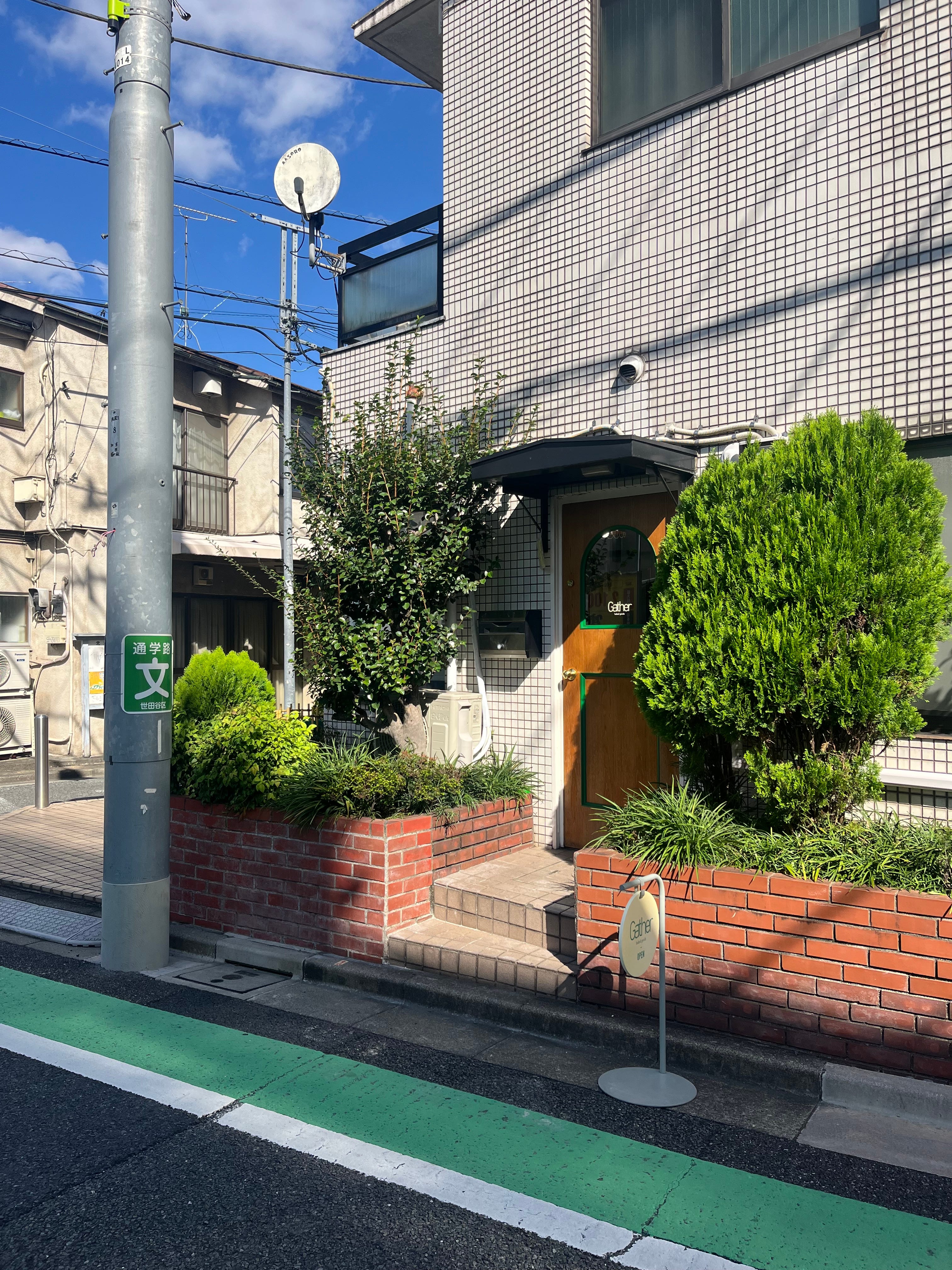
and not just because of its size—it is winding, ordered, largely gridless, and fraught with side streets and alleys—yokochōs—that reward curiosity and subvert expectations. This part of Tokyo was more residential, with streets made for walking; many don't have sidewalks, so people walk directly on the street itself; there is no on-street parking, so unsightly Toyotas or visually incongruent Hondas never tarnish the view of the buildings and neighbors; and the streets themselves are colorful, with red and green and white markings instead of the black and yellow we're used to in the West.
Within a few blocks the density of businesses increased. I saw a small grocery, countless izakaya, railroad tracks(!!) with yellow bicycles and shimmering flowers and long grasses, a small cooking class shop, and even an English school that was hiring teachers. I let myself wonder, be reminded of a college friend who had moved to Japan to teach English after graduating, someone with whom I'd lost contact.
I wonder how much of life we dull ourselves to, plugged in to our phones.
How lazy our powers of observation become when we rely on Google Maps. How might we change that about ourselves? To see the world as it might actually be, and not in abstractions. To look at the map to understand the world; to look at the world to understand the map.
I opened the little bag where I had the slice of pumpkin pie from the bakery. One doesn't really eat en plein air and wander in Tokyo—at least not that I observed—but I let myself enjoy that pie slice as I meandered. Oh my goodness—this was the best pumpkin pie of my life. The bottom was crisp like a croissant; the filling wasn't too sweet but perfectly spiced, the perfect blend of pumpkin, cinnamon, and cardamom. It felt criminal, holding it with its little wax paper wrapping in one hand, biting into it street-side, in motion. Everything in Japan has its place, and this pie slice's place was on a plate, at a table, savored delicately with a petite fork. Traveling really is a series of small indignities.
Would I have found this street on my own? Surely, this was the kind of experience that flâneur-ing promised, the unknown-to-you delights nestled in a faraway corner of Tokyo, the kind of quiet image that lures one to return to a place in hopes of recreating the experience—a sunny, crisp autumn day in quiet Setagawa City, enjoying the best slice of pumpkin pie of my life, crossing the railroad tracks by the flowers where old women pulled carts, not a care in the world, not a single destination in mind.
In France, the flâneur needed to be affluent.
Detached from the world. Possessing a certain je m'en fous. One wandered without a map. The lack of information, it seems, was by design.
Today I am not so sure. Our tools and tech influence how we interact with the world in a way so irreversible that I am not certain we could ever faithfully recreate the experience of the 19th-century flâneur. In any case, I do not believe that would be a useful aspiration—we are modern people, irrevocably shaped by the technology and tools we use. It might be useful to hone our sense of perception, to practice that which we might have forgotten, to be comfortable with getting a little lost.
Wandering might not have a purpose—the purpose may be in having no purpose, in being open to what we find—but:
I wonder how we can find the balance between looking at the map and looking at the world.
Maps do more than create abstractions of space: they are also snapshots of the world as it was in a time that is necessarily no more. Perhaps that is what I am doing as I wander and annotate my Google Maps: I create an atlas of my youth, a sort of digital, topographical traveler's diary, made not of pages and words but directions, streets, places, and vignettes. Tokyo, well-walked, exists as a mental collage.
I abstract the world in order to better see it; there is simply too much information to process otherwise.
When I'd found a charger and powered on my phone,
I opened Google Maps and navigated to that street I'd been so enamored with. I probably would not have found it on my wanderings—it was marked residential, with none of the yellow highlighting that announces an area as interesting to the user, and the names and nature of the businesses only became apparent when I zoomed in. I noticed a Taiwanese restaurant that I hadn't seen, just off the railroad tracks.
I remembered turning around to admire the scene; I had stared straight at that building, with all the alacrity of the stark sunlight, my powers of attention turned up, determined to inhale every detail of a scene I might never return to.
There is so much detail in the world, so much that even I, a practiced flâneur, simply miss things.
We each notice different things, Google Maps and I. Perhaps that is for the best.
This essay came together after several rounds of feedback from Brigitte Kratz, Camilo Moreno-Salamanca, Coco Liu, Emily Ann Hill, Jasmine Aug, Nat Lee, and Rachel Parker of Fragments of Humanity.